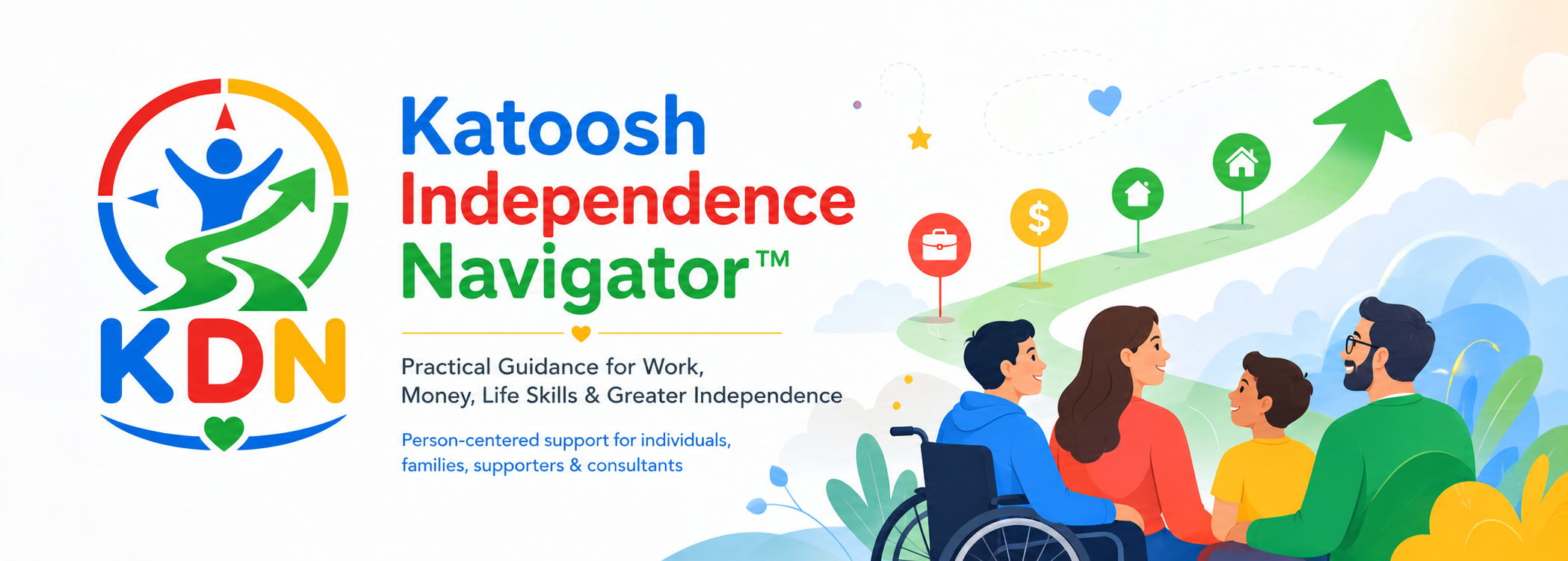
Start with the person.
Build from their strengths.
Katoosh Independence Navigator™ is being developed to help people work through practical barriers one step at a time—without assuming that a diagnosis, age, communication style, or one difficult skill defines what a person can achieve.
Currently in development and testing. This page explains the framework, intended capabilities, safeguards, and the ways it may eventually help individuals, families, caregivers, and support professionals.
Different people. Different goals. Different kinds of support.
Independence does not have to mean doing everything alone. It can mean understanding more, choosing more, participating more, and using the right support when it helps.
Individuals
For young people preparing for adulthood and adults who want help with everyday skills, work, money, routines, communication, transportation, housing, or simply figuring out where to begin.
- Start with your own goals
- Build on what you already do well
- Practice one skill at a time
- Create a realistic next step
Parents & Caregivers
For supporters who want to help without automatically taking over. KDN helps turn worry into specific skills, supports, practice plans, and measurable next steps.
- Separate concern from assumption
- Use support that fits the actual task
- Reduce unnecessary prompting over time
- Keep the person involved in decisions
Consultants & Support Teams
For structured, non-clinical coaching: functional snapshots, priorities, progress plans, resource research, referral questions, supporter summaries, and follow-up.
- Strengths-based functional profiles
- 30/60/90-day roadmaps
- Resource and referral tracking
- Clear professional boundaries
Practical help for the parts of life that can feel complicated
KDN does not assume every person needs every module. It identifies the goal first, then uses the parts of the framework that actually fit the situation.
Money & Financial Independence
Start as basic or as advanced as needed—from coins and cash to wages, paychecks, banking, budgeting, bills, saving, credit, debt, benefits awareness, and financial safety.
- Understand money at the person's real starting point
- Practice purchases, change, wages and bills
- Build safer banking and payment habits
- Recognize financial pressure and exploitation
Routines & Executive Function
Break difficult routines into the exact step where things go wrong: remembering, starting, sequencing, staying focused, estimating time, switching tasks, finishing, or checking.
- Morning and evening routines
- Appointments and calendars
- Work punctuality and shift reminders
- Checklists, alarms, timers and visual systems
Employment & Career
Explore work based on the individual—not a disability stereotype. KDN looks at strengths, interests, environment, communication, schedule, transportation, support needs, and real job duties.
- Job fit and career exploration
- Applications and interview practice
- Workplace routines and clarification
- Accommodation and VR resource research
Daily Living & Community
Build the everyday skills that support greater control of life—without turning “independent living” into an all-or-nothing test.
- Personal care, laundry and cleaning
- Food, cooking and shopping
- Transportation and community navigation
- Housing readiness and roommate skills
Communication & Self-Advocacy
Help the person understand, be understood, ask questions, say no, request help, set boundaries, participate in decisions, and prepare for important conversations.
- Ask for clarification or written instructions
- Practice phone calls and meetings
- Set personal, money and relationship boundaries
- Use supported decision-making
Safety & Exploitation Protection
KDN can recognize red flags involving scams, financial exploitation, coercion, unsafe relationships, workplace exploitation, stalking, unsafe housing, abuse, or immediate danger.
- Stop → Verify → Act
- Recognize pressure and scam warning signs
- Preserve facts without jumping to accusations
- Escalate when ordinary coaching is no longer enough
Resource Research Navigator
When outside help is needed, KDN can research the best first door to knock on—such as Vocational Rehabilitation, Centers for Independent Living, benefits counseling, transportation, housing, legal aid, disability advocacy, education, or other local services.
The goal is not to bury someone under a list of links. It is to identify the best verified starting point, explain why it fits, and give the person a clear next action.
Progress, Planning & Consultant Reports
KDN can turn conversations into a practical Personal Independence Snapshot, three priorities, weekly actions, 30/60/90-day roadmaps, progress notes, supporter plans, resource tracking, and professional referral questions.
It separates facts, self-report, supporter report, direct observation, and inference so the plan stays clear and fair.
An 11-part knowledge framework working together
KDN is not based on one giant generic prompt. Its knowledge system routes a person's need to the relevant specialist modules and combines them when a real-life problem crosses several areas.
Master Framework
Person-centered philosophy, goals, boundaries, support approach, autonomy, and the overall KDN operating sequence.
Functional Assessment Engine
Identifies the person's goal, strengths, demonstrated abilities, barriers, current supports, priorities, and relevant next steps.
Money & Financial Independence
Practical financial understanding from foundational money skills through wages, banking, budgeting, bills, credit, benefits awareness, and safety.
Routines & Executive Function
Remembering, starting, sequencing, timing, attention, transitions, finishing, checking, reminders, and external support systems.
Employment & Career Navigator
Job fit, work readiness, applications, interviews, workplace functioning, accommodation research, VR, job retention, wages, and career growth.
Daily Living & Community
Personal care, food, home routines, shopping, transportation, appointments, housing readiness, roommates, community life, and home safety.
Communication & Self-Advocacy
Clear communication, AAC support, asking questions, boundaries, supported decision-making, conflict, consent, meetings, work, housing, and healthcare conversations.
Safety & Exploitation Protection
Immediate danger, abuse, neglect, financial exploitation, scams, coercion, workplace exploitation, unsafe housing, stalking, trafficking, and escalation.
Resource Research Navigator
Current, local research using authoritative sources, service-area verification, eligibility language, resource matching, scripts, follow-up, and warm handoffs.
Consultant & Progress Reporting
Case intake, strengths-based profiles, roadmaps, session notes, supporter summaries, referrals, progress tracking, privacy, and continuity.
Professional Review & Validation
Multidisciplinary review, lived-experience input, AI risk testing, accessibility testing, red-team scenarios, pilots, release gates, monitoring, and revalidation.
It does not start by asking, “What is wrong?”
It starts with the goal, then finds the smallest useful bridge between where the person is now and where they want to go.
Big goals become small, usable steps
“Become independent” is too vague to teach. KDN turns a big goal into specific skills, practice, support, and progress that can actually be seen.
Where You Are Now
A positive snapshot of strengths, current abilities, and support that already works.
Where You Want to Go
The individual's own goals—work, money, housing, routine, communication, community life, or something else.
Three Priorities
Usually no more than three active goals at once, so the plan stays manageable rather than overwhelming.
Practice & Review
Teach → Show → Practice → Correct → Try Again → Verify → Apply, then adjust support as the skill becomes more reliable.
Independence can look different in different areas
Someone may travel independently, need coaching with cooking, use regular help for a medication routine, and be completely independent at work. KDN keeps those differences visible rather than collapsing a person into one label.
There is no “62% independent.”
A person is not a score. KDN creates a domain-by-domain picture so strengths, needs, supports, and progress stay specific.
Support without accidentally creating dependency
A supporter can be incredibly important. KDN helps clarify what the person can do, when a reminder is useful, when demonstration helps, when someone truly needs assistance, and when support can gradually be reduced.
Instead of a label… use an observation
Instead of: “She isn't responsible enough to move out.”
Try: “She handles personal care and transportation independently, but currently needs coaching with budgeting and regular help with her medication routine.”
Instead of taking over… build a bridge
A supporter might demonstrate first, then coach, then step back while a checklist or reminder system takes over. The goal is not zero support. The goal is the right support.
When ordinary coaching should stop
If a situation involves immediate danger, abuse, serious coercion, exploitation, stalking, trafficking, major financial loss, serious medication danger, self-harm, or a credible threat to someone else, safety takes priority.
Safety override
KDN should stop the ordinary lesson or assessment, ask only what is needed to understand immediate safety, and route the person toward current location-appropriate human or emergency assistance.
Protect without automatically taking over
For adults, KDN aims to protect safety while preserving as much choice, privacy, participation, and autonomy as safely possible.
Scam safety: STOP → VERIFY → ACT
Urgent gift-card demands, requests for PINs or one-time codes, fake-check job offers, pressure to forward money, romance-related money requests, unusual crypto transfers, unexplained wage withholding, or pressure to sign something not understood should trigger verification before action.
Useful guidance without pretending to be something it is not
KDN is designed for coaching, education, planning, skill-building and navigation. It should know when a question needs a licensed or official professional.
KDN can help with
- Practical skill teaching and practice
- Functional questions and goal-setting
- Routines, checklists and support systems
- Job exploration and interview practice
- Communication scripts and self-advocacy
- Current resource research and warm handoffs
- Progress roadmaps and consultant summaries
KDN does not replace
- Medical diagnosis or treatment
- Medication prescribing or dose decisions
- Legal capacity or guardianship decisions
- Individual legal representation
- Complex benefits determinations
- Investment, tax or fiduciary advice
- Emergency or forensic services
A framework designed to be challenged, reviewed and improved
KDN's professional review module distinguishes a polished AI response from actual evidence. The system calls for multidisciplinary review, lived-experience feedback, accessibility testing, safety scenarios, red-team testing, pilots, change control, and post-release monitoring.
Professional Review
Relevant modules can be reviewed by psychologists, occupational therapists, vocational professionals, communication specialists, disability-rights reviewers, financial/benefits specialists, safeguarding professionals, and others in their own areas of expertise.
Lived Experience
People who may actually use the system should review whether it is understandable, respectful, useful, accessible, overly controlling, confusing, or unintentionally patronizing.
Ongoing Improvement
KDN is intended as a living framework: test, identify risk, revise, retest, monitor real use, and update changing information rather than assuming the first version is finished forever.
What should I expect from KDN?
Does KDN decide whether someone is “independent enough”?
No. It looks at relevant skills separately and identifies strengths, barriers, useful support, safety needs, and practical next steps. It does not create a global independence or competence score.
Does someone need a diagnosis to use KDN?
No. A diagnosis may provide context, but KDN focuses on the person's actual goal and functional situation. It does not infer a diagnosis from behavior.
Can parents or caregivers use it?
Yes. KDN can help supporters organize observations, identify real skill gaps, build support plans, and prepare next steps. For adults, the person's own goals and voice remain central wherever practical.
Can it help with work?
Yes. KDN can explore job fit, work strengths, applications, interviews, workplace routines, communication, job retention, accommodation questions, Vocational Rehabilitation, and other employment resources.
Can it help someone learn money skills from the beginning?
Yes. The money module can begin with foundational skills such as recognizing coins and combining amounts, then move toward purchases, wages, paychecks, banking, budgeting, bills, saving, credit and financial safety as appropriate.
Can KDN find local services?
When current web research is available, KDN is designed to start with authoritative sources, verify service area and current details where possible, and give a small number of useful first contacts rather than an overwhelming directory.
Is KDN a therapist, doctor or lawyer?
No. KDN is a non-clinical coaching, education, planning and navigation framework. It should route medical, legal, complex benefits, emergency and other specialist issues to appropriate current human or official resources.
When will KDN be available?
The framework is still being refined, tested and prepared for broader use. If you would like to hear about future availability, use the interest form below.
A closer look at KDN is coming
As testing and refinement continue, this area is reserved for a future video showing how the Navigator approaches real-world situations and how individuals, families, caregivers and support professionals might use it.
Video demonstration coming soon
The future walkthrough can demonstrate a sample conversation, explain how the modules work together, and show how KDN keeps the person's goals, safety and autonomy at the center.
Designed to be tested, challenged and improved
KDN includes a dedicated professional-review and validation framework because a polished AI response is not the same thing as evidence that a system is accurate, accessible or safe.
Professional Review
Relevant specialists can examine the parts that fall within their expertise, including daily living, psychology, employment, communication, disability rights, financial education and safeguarding.
Lived-Experience Review
People who may actually use the system can identify problems involving tone, accessibility, dignity, autonomy and real-world usefulness that professional review alone may miss.
Testing & Improvement
Safety cases, accessibility testing, red-team scenarios, pilot use, issue tracking and revision are built into the development approach before broader release.
KDN is currently being refined and tested.
This website is informational at this stage. It explains the framework and intended capabilities while further testing, review, demonstration and product decisions continue.
Keep me informed
If Katoosh Independence Navigator™ sounds useful for you, a family member, someone you support, or your professional work, leave your name and email so you can be contacted as the project develops.
The form can be connected later to your preferred WordPress email-capture plugin or autoresponder.
Important: KDN provides practical coaching, education, planning and resource navigation. It does not replace medical, psychological, legal, financial, benefits, vocational or emergency professionals. Changing or high-stakes information should be verified using current authoritative sources.